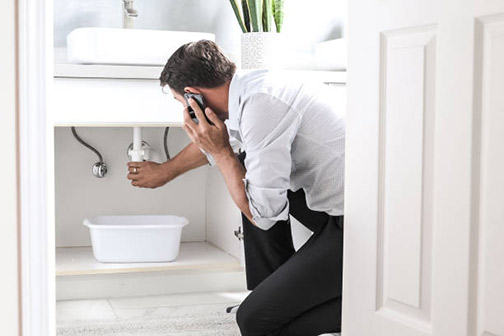
How many times have you found yourself in this situation? You know your sink is leaking, but you just can’t find the exact location of the leak. Consequently, even after trying numerous tricks and tips, the problem in your sink persists.
If you still have that problem, this post will help you fix it.
Why are sink leaks often hard to diagnose? In design and operation, Keyrenter South Florida notes that sinks are really simple plumbing fixtures. A sink is a bowl-shaped fixture used for washing. But when you add different connections to it, a sink becomes a complex system.
Leaks can occur in any one of your sink connections, faucets, water supply lines, drainage pipes, P-Trap, and shut-off valves. These leaks do not always happen overtly, and if undetected, they will not only inflate your water bill but also cause expensive water damage to your home.
Here is how to detect the underlying cause of a sink leak in your home.
- Faucet leaks
If the faucet is leaking from its base, check for gaps or signs of rust at the base of the faucet. Most faucets sit on a base plate. The edges of this plate should be sealed with putty to keep water from getting through. If the faucet is loose, the putty has worn out or hardened. Tightening the nuts and reapplying putty around the base plate should solve this problem.
Your faucet may also leak from the spout if the O-rings are worn or the securing ring is loose. To check if this is the source of the leak, loosen the nut at the base of the spout to inspect the O-rings and securing ring. If the O-rings are worn, replacing them will stop the leaks. Applying heat-proof grease around the securing ring also helps stop leaks.
- The sink drain
Leaks can also happen underneath your sink. If something, maybe a trash can, knocks really hard into the drainage pipes or garbage disposal, you may have leaks. If water is coming from the underside of your sink, the basket strainer could be leaking. To make sure this component is not loose, tighten it with a channel lock (tongue-and-groove pliers).
Leaks also happen at the joint between the basket strainer and the drainage pipe. Remove the pipe by loosening the slip nut and check that the insert at the neck of the pipe (which should seal the connection) is in good condition. Applying Teflon pipe dope to the inside and outside of the pipe before replacing it will help to seal up the joint.
The P-trap underneath your sink can also leak. The most common causes of P-trap leaks are a loose slip nut and a cracked pipe. Undo the P-trap and inspect the threads at both ends of the pipe to make sure there are no cracked or chipped sections. If there are, replace the P-trap. If the P-trap is not damaged, put it back and tighten the connection (by hand).
- The water supply lines
This is another common site for leaks. These leaks are usually the result of corroded parts and loose connections. To check if the water supply lines are leaking, dry the lines, shut-off valves, and connections with a paper towel. Run the faucet and use a dry paper towel to feel for leaks around the water supply line, shut-off valve, and pipe joints.
Leaks here could be due to a loose connection at the point where the flexible hose meets the faucet or shut-off valve. The shut-off valve may also leak around the stem. To fix a leaking hose, tighten the connection. If this doesn’t work, you may need to replace the hose. Stainless-steel braided hoses are more durable.
If the leak is from the stem of the shut-off valve, the best option is to replace the device. If this is not immediately possible, applying silicone tape or epoxy to the leak will temporarily handle the problem. This is not a permanent solution; the shut-off valve should be replaced as soon as possible.
- The garbage disposal
Leaks may also happen at the garbage disposal. A garbage disposal can leak at the O-ring, around the top of the appliance, or at the bottom. If the garbage disposal is leaking at the O-ring (the point where the drainpipe connects directly to the appliance), the problem can be fixed by disconnecting the pipe to clean it and check – and maybe replace – the O-ring.
If the garbage disposal leaks from the top, fix the problem by checking that the connection to the sink is not loose. Tightening the nut should stop any leaks. However, if the garbage disposal is leaking from the base, there is no easy fix for the problem. The best solution for a garbage disposal that leaks from the bottom is to replace it.
Conclusion
Doing these steps should fix your leaky sink. However, if you are still unable to find the cause of the problem after following these steps, you may want to call a professional plumber.