Chicago’s Department of Water Management purifies approximately one billion gallons of safe drinking water every day for use by the city’s inhabitants and the people living in its suburbs. Beyond Property Management notes that when this water leaves Chicago’s water treatment plants, it is perfectly safe for drinking.
However, between the treatment plant and the faucets in homes, contaminants may enter the water, making it less safe for drinking. Most of this contamination is from lead pipes, which still make up a significant portion of the city’s water service lines.
Chicago has a long-standing problem of lead pipes in its plumbing systems. It was only fairly recently (1986) that the city stopped using lead water lines. However, since then, action to remove existing lead service lines, which have been in place since the 1800s, has been slow.
The result is that among US cities, Chicago has one of the highest levels of lead contamination in its water supply. But lead contamination is not the only thing Chicagoans have to worry about. There is also evidence of chromium VI, mercury, and radium in the water supply.
This is in addition to the fact that Chicago’s water is hard. While not a health hazard, hard water causes major problems in homes; limescale buildup from hard water shortens the lifespan of plumbing fixtures and appliances, reduces the efficiency of soap, and leaves unsightly stains on things.
To handle these issues, many of the city’s residents now resort to installing water filtration systems in their homes. Instead of waiting for the government, these systems give Chicagoans some control over the quality of the water entering their homes.
How do Chicago water filtration systems work?
The two types of home water filtration systems commonly used by Chicago families are: whole-house filters and point-of-use systems.
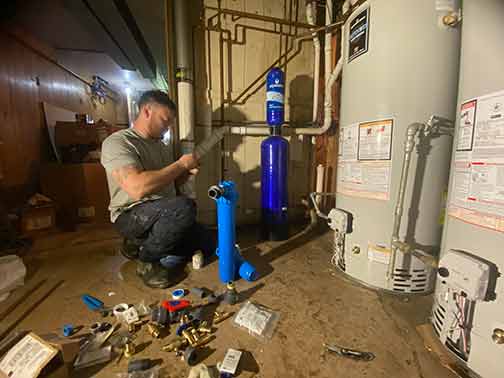
Whole-house water filtration systems filter water at the main point where it enters the house. By filtering water at the source, this system ensures that the water flowing from every fixture and into your appliances is filtered. Whole-house systems will give you total control of your water quality.
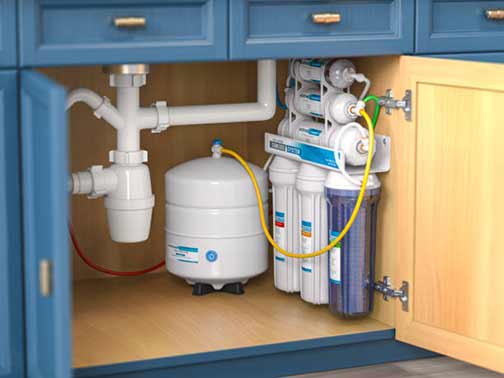
Point-of-use (POU) water filtration systems filter water at specific locations in the house, like the kitchen sink. They are for those who only want to filter water for certain uses in their home, such as drinking or cooking. They are mounted on or around the fixture where the water is coming from.
Apart from their mode of operation, water filtration systems use different filtration methods: carbon filters, ceramic filters, deionization filters, distillation, UV filters, ozonation, and reverse osmosis. Reverse osmosis and carbon filter systems are used by a far greater number of households.
Carbon filters are the most familiar type of water filtration system. They use activated charcoal, which bonds with contaminants as the water flows through the system. Carbon filter systems are effective for removing chlorine (a major issue in Chicago’s water) as well as mercury, lead, asbestos, and volatile organic compounds (VOCs).
Reverse osmosis systems remove a wide range of pollutants by forcing the water to pass through a semipermeable membrane. These systems filter out metals (lead, mercury, and iron), calcium, asbestos, dissolved salts, and microorganisms from the water supply. They do not always remove chlorine and VOCs.
Benefits of installing a water filtration system
- No more hard water
Hard water affects almost everything in your home. Limescale and scum deposits on fabrics cause them to fade and wear out faster. Hard water leaves ugly stains on glass, dishes, tubs, and bathroom tiles. It reduces the efficiency of soap and increases the risk of drain clogs and blockages in your home. Hard water also impairs the function of appliances and plumbing systems, while shortening their lifespan. Hard water can damage your hair and skin.
- Improved health and well-being
Water filtration systems routinely remove dangerous chemicals and metals from the water supply. Chicago’s water supply sometimes contains things like arsenic (a known carcinogen), aluminum (implicated in neurological disorders like Alzheimer’s), lead (a heavy metal that is harmful to the cognitive development of children), fluoride (an immune suppressant) and chlorine (a residue of the water purification system that can cause bladder issues).
- Massive cost-saving
Installing a water filtration system helps minimize plumbing maintenance costs by reducing the rate of limescale buildup and corrosion inside your plumbing. The rate of wear and tear on appliances also reduces. Water filtration systems have a huge positive impact on a family’s health bill because they eliminate skin and hair issues resulting from water hardness. Overall, families spend less money on bottled water because the filtered water in the home is safe to drink.
What are the things to look out for when installing a water filtration system?
The right water filtration system for your home depends on the kind of pollutants in the water supply. Before installing a water filtration system, it is critical to have the water tested by a certified company that does EPA-certified testing.
Secondly, buy an NSF (National Sanitation Foundation) certified product. These have undergone rigorous testing and are guaranteed to give the best results. Lastly, you need a reliable Chicago plumber to guide you through the process.