All plumbing systems, whether installed in a residential or commercial building, have two distinct parts. First, there is the part that handles the building’s fresh water supply. Then there is the part that transports wastewater from all the plumbing fixtures out of the building.
Although they always work in a tight synergy, TrueDoor Property Management notes that these two parts of the plumbing must remain separate at all times. Think what would happen if the fresh water running to your faucets got mixed up with the dirty water flowing from your shower.
Not only would your home’s water supply become contaminated, but the worst part is, you might not even know that this is happening inside your plumbing. This problem is caused by backflow, one of the least understood yet lethal issues in plumbing systems.
Understanding the basics of backflow: causes, effects, and signs
In the simplest terms, backflow refers to the reverse flow of water or other liquids in plumbing pipes. Normally, the clean water, gas, or wastewater inside your pipes should flow in one direction. Clean water, for instance, should enter the home via the main water supply line and exit through the faucets.
However, problems can happen in the system that interrupt this order, forcing the water or gas in the pipes to flow in the opposite direction, often with disastrous consequences. This is usually due to significant pressure changes in the pipes or severe demand imbalances in the system.
The causes of backflow in plumbing systems can be divided into two categories:
- Back siphonage
This occurs when negative pressure in the supply line creates a suction force that pulls contaminated water backward into the potable water system. Common causes of back siphonage include: high demand by nearby firefighting equipment, water main breaks, and pipe repair works.
- Back pressure
In this instance, pressure in the non-potable water section of the system becomes higher than the pressure in the clean water section, forcing contaminated water to push backwards and mix with the clean water. Common causes are pipe blockages, faulty valves, and tight bends in the pipes.
The main effect of backflow is cross-connection, a bridge in the plumbing system that allows potable water to meet and mix with non-potable water. This introduces contaminants like sewage, soil, pesticides, herbicides, and others into the clean water supply.
What are the signs of backflow in a plumbing system?
Backflow is hard to detect because most signs of the problem can also be attributed to other causes. If you detect the following problems in your home or office building, please check your plumbing system for backflow.
- Inexplicable changes or fluctuations in the building’s water pressure.
- Strange smells and tastes in your water, as well as water discoloration.
- Unexplained increases in your water bill are often a sign of a major hidden leak.
- Slow, clogged, or blocked drains in your home, especially if the problem is recurring.
- Recent firefighting activity near the building.
The best way to detect backflow in your plumbing is to test the system. The ultimate defense against backflow in your home or office is to install a backflow preventer in your plumbing. What is a backflow prevention system, and how does it work?
Backflow prevention devices and how they work
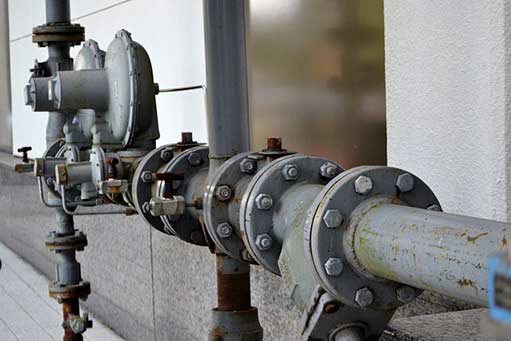
A backflow device is a gate that ensures the water inside your pipes flows only one way. If there is a risk of flow reversal due to changes in water pressure, the backflow preventer will shut the pipe and provide a way to rebalance the pressure inside the system. How does this work in real life?
To prevent backflow, the backflow preventer uses a series of checkpoints. These are check valves that open and close according to the water pressure in the system. When pressure is normal, the valves open to allow upflow travel, but when pressure rises, they close to prevent reverse travel.
Typically, a backflow preventer has two gates with an empty space between them, a diaphragm activated by pressure, and a vent. If there is excess pressure coming from the discharge side of the system (the non-potable supply section), the valve on the supply side closes.
The water flowing backwards enters the space between the valves before exiting the system through the vents. That way, contaminants in the downstream section of the plumbing are kept out of the potable water section of the system. There are several types of backflow devices.
The most common ones are:
- Atmospheric Vacuum Breakers (AVB)
- Pressure Vacuum Breaker (PVB)
- Double Check Valve Assembly (DCVA)
- Reduced Pressure Zone Assembly (RPZA)
All of these different types of backflow preventers operate on the same basic principles but with slight differences. However, some of them are only suitable for specific applications.
If you suspect you have backflow issues in your building and are considering installing a backflow preventer, how do you choose the best one for your plumbing? Start by testing your plumbing, and based on the results, your plumber can recommend the right backflow device for your building.