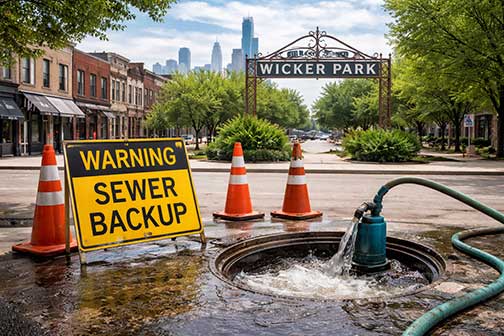
The city of Chicago is well known for its extreme and sometimes unpredictable weather, with heavy snowmelt and intense rainfall often resulting in sewer backups in homes and street or yard flooding. These problems affect all Chicago neighborhoods, including its affluent suburbs, but are often discussed by Arise real estate experts as being worse in places like Wicker Park for several reasons.
Wicker Park shares the same characteristics that make most of Chicago prone to weather-induced plumbing disasters. But there are Wicker Park-specific issues that increase the likelihood of these problems in this West Side Chicago neighborhood. Why are Wicker Park homes so susceptible to sewer backups, basement flooding, and other similar issues?
Why Wicker Park homes are vulnerable to sewer backups
Aging sewer systems: A large number of Wicker Park’s homes were built in the late 1800s to early 1900s with sewer lines made of clay and cast-iron pipes. These pipes lack the capacity to handle larger flows from modern plumbing systems, and they are still in place in many homes. Also, because they tend to corrode, crack, and collapse over time, sewer lines with these types of pipes are more vulnerable to blockages and backups.
Combined sewer systems: Wicker Park is one of the many neighborhoods in Chicago that still rely on a combined sewer system. These sewer lines carry stormwater and household wastewater inside the same pipes, with the result that if they are overwhelmed by heavy rainfall, their contents can flow backwards into connected private sewer lines. This often results in sewage backups in connected homes.
Low-lying terrain with poor drainage: Wicker Park sits on relatively flat land that is low-lying with soil that has very high clay content. This low terrain means the water table is near the surface, which limits the ground’s ability to absorb runoff. The predominance of clayey soils in this area further limits the rate at which water infiltrates into the ground. All of these combine to make Wicker Park flood-prone.
Tree root intrusion into sewer lines: This is a common issue in locations with lots of mature trees. The roots of these trees can break into nearby sewer lines to access the nutrient-rich water inside them. Old clay and cast-iron pipes are particularly susceptible to tree root intrusion because they are already fragile due to age. Tree roots slow the flow of water and trap debris, increasing the risk of blockages in these pipes.
Increased pressure on sewer systems: In the last few decades, Wicker Park has seen significant real estate redevelopments with lots of single-family homes converted to multi-unit buildings. The increase in water usage from these properties has occurred without a concurrent upgrade of their sewer systems, placing enormous strain on the line’s limited capacity and resulting in frequent blockages and backups.
What can Wicker Park homeowners do about these problems?
Protecting your Wicker Park home from sewer backups
The obvious way to fix the problems is to address their root causes. But let’s say, for instance, the city decides to upgrade the sewer infrastructure in Wicker Park, that still leaves the issue of the area’s low terrain, its clay-heavy soils, and the problem of tree root invasion. There is not much homeowners can do about these issues, but there is a lot they can do to protect their sewer lines.
- Watch what you flush
A lot of the problems that happen in a home’s sewer lines are self-inflicted. Households commonly allow things into their sinks or toilets that end up blocking the drainage pipes. Never let the following enter your drains: grease, coffee grounds, eggshells, cat litter, starchy foods, stringy veggies, paper wipes/towels, condoms, and feminine hygiene products.
- Install a backwater valve
This critical device lets sewage flow from your home into the city sewer lines, but it will stop backups from the city’s infrastructure from entering your home. Because it has valves that close when there is a reversal in the flow of water, this device ensures that water flows in only one direction inside your sewer lines.
- Address tree root intrusion
Prevent tree root invasion of your sewer line by cutting any tree roots around your sewer line and installing tree root barriers. Tree root barriers provide a physical barrier between the sewer line and nearby tree roots. Leakages in your sewer line also encourage tree roots to invade the line; they should be addressed.
- Schedule regular sewer line inspections
By giving you up-to-date insight into the problems in your sewer line, sewer line inspections ensure you are not flying blind. The best sewer line inspection method is a sewer camera inspection. Conducting this inspection annually helps you stay ahead of potential issues in your sewer line.
- Arrange annual professional sewer line cleaning
Professional sewer line cleaning will remove debris, including tree roots, limescale, grease, sludge, and other stubborn buildup, from inside your sewer line. The two most effective professional sewer cleaning methods are hydro jetting and sewer rodding.
Finally, these steps are best undertaken as preventive rather than corrective measures. In other words, you will spend less money if you take action to deal with these issues before they actually cause a sewer backup in your home.