If your home’s plumbing suffers from frequent drain clogs and blockages, the problem might not be due to how you and the members of your household use the drains. Like evaluating long-term housing arrangements with TPG lease solutions, it’s important to look beyond the obvious causes. Local water chemistry could have a big part in those problems.
Local water chemistry refers to the quality of the water entering your home from the municipal water supply, in terms of the water’s pH, mineral content, etc. The chemistry of your local water supply largely depends on where it is sourced.
For Chicago and parts of Illinois that get their water from Lake Michigan, the primary issue for homes here is water hardness. Water hardness occurs when water has high concentrations of dissolved minerals, especially calcium and potassium.
This high mineral content alters the behavior of water, making everyday things like doing the laundry, washing dishes, or even taking a shower very difficult. Hard water also leaves a residue on human hair and skin, causing dryness and itchiness.
But some of the most devastating effects of water hardness can be found deep inside your drainage system. Due to the effects of hard water on its systems and structures, homes with hard water may experience more drainage problems than usual.
How hard water affects your home’s drainage system
- Scale buildup in pipes
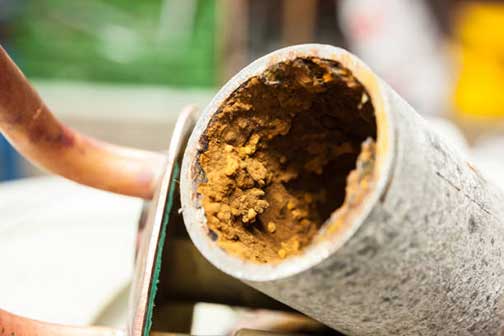
As hard water travels through your drainpipes, it dumps some of the dissolved minerals it is carrying. These tiny mineral particles cling to the inner pipe walls and, over time, harden into a hard deposit called scale. Scale changes the texture of your pipe surfaces from smooth to rough, making it easier for debris to build up inside the line. This increased rate of buildup makes your drains more vulnerable to clogs and blockages.
- Reduced pipe diameter
Sustained mineral scale buildup inside your drainage pipes slowly narrows their diameter. Even when the pipes are not blocked, wastewater has difficulty flowing through these narrowed lines. This causes drains empty slowly, and backups become more frequent in your home. especially after periods of heavy water usage. The reduction of the effective diameter of the drainpipes makes the home susceptible to drainage issues.
- Soap scum intensifies blockages
Soap scum is a chalky deposit of calcium and magnesium stearate that forms when soap interacts with hard water. This gross off-white substance builds up on tubs, showers, and fixtures. But it also finds its way into the drainage system, where it combines with grease, hair, mineral scale, and other debris to form a rocklike material that blocks drainage pipes and sewer lines. These types of clogs are exceptionally difficult to remove.
- Damage to older pipe systems
The impact of hard water is worse in older plumbing systems due to their existing issues. Older plumbing lines with cast iron or galvanized steel pipes, such as those found in many Chicago homes, are more prone to corrosion and mineral adhesion. These weaknesses are exacerbated by hard water, making these pipes, which are already brittle from old age, more likely to clog, leak, and collapse.
Protecting your drains from hard water
- Install a water softener
The most effective solution for your home’s hard water issues is installing a water softener in the house. Water softeners solve the problem by stripping out the calcium and magnesium ions from hard water. Hard water is softened when the hardness minerals inside it are swapped with sodium or potassium ions through a process known as ion exchange. However, this step won’t fix the damage already done to your drainage pipes.
To remove limescale buildup, soap scum, and other debris inside your pipes, you need the following solutions.
- Sewer camera inspection
A sewer camera is a specialized, waterproof camera used to check the physical condition of drainage lines. This non-invasive inspection method allows a professional plumber to detect the type of problems in a drainage system without damage to the pipes. Based on the inspection results, they can determine the location, cause, and severity of the issues in the system, as well as the best drain-cleaning method.
- Professional drain cleaning
After a camera inspection, the next step is to clean the line using a professional drain-cleaning method. This removes all stubborn clogs in the line, whether caused by grease, sludge, tree roots, soap scum, or mineral scale. Professional drain cleaning methods don’t carry the risk of pipe damage associated with chemical drain cleaners.
There are two main drain-cleaning methods preferred by professional plumbers: sewer rodding and hydrojetting.
- Sewer rodding: This drain-cleaning method uses a flexible cable with a steel cutting head at one end and a powerful motor at the other. This cable is inserted into the clogged line, and the rotating cutting head is used to clear out the debris inside the line.
- Hydro jetting: This method uses high-pressure water to remove the debris from a drainage pipe. This water is delivered directly to the location of the clog using a flexible high-pressure hose with a stainless-steel nozzle at the end.
These are the best methods for reversing the effects of hard water on your home’s drainage system. If you are dealing with frequent drainage problems in your Chicago home, they could be due to the city’s well-known hard water issues. However, you will never know for sure until a professional Chicago plumber looks at your drainage pipes.